What Are the Top Medical Accessories for Hospitals?
A hospital’s most useful medical accessories are often easy to overlook: a blood-pressure cuff beside the bed, a pulse oximeter on a clean trolley, or a secure stand holding an infusion bag. Yet small tools shape daily care. They help staff measure, monitor, move, and protect patients. They also affect how smoothly a ward runs. Details matter.
Hospital-care pioneer Florence Nightingale wrote, “It may seem a strange principle to enunciate as the very first requirement in a Hospital that it should do the sick no harm.” Her principle remains relevant when teams choose accessories. A device should suit its clinical purpose, be comfortable to use, and withstand routine cleaning. Fit matters. So does clear labeling. A poorly placed cable or an ill-fitting cuff can complicate a task, even when the main equipment works well.
This article explores common hospital essentials, including monitoring devices, mobility aids, patient-support products, and protective equipment. It considers practical factors such as durability, compatibility, maintenance, and ease of use. Needs differ between intensive care, operating rooms, and general wards, so no single checklist fits every hospital. That deserves honest attention. A product that works well in one setting may frustrate staff in another. The best choices are not always the newest or most expensive; they are the ones that reliably support safe, consistent care.
Classify Hospital Medical Accessories by Clinical Task and Care Setting
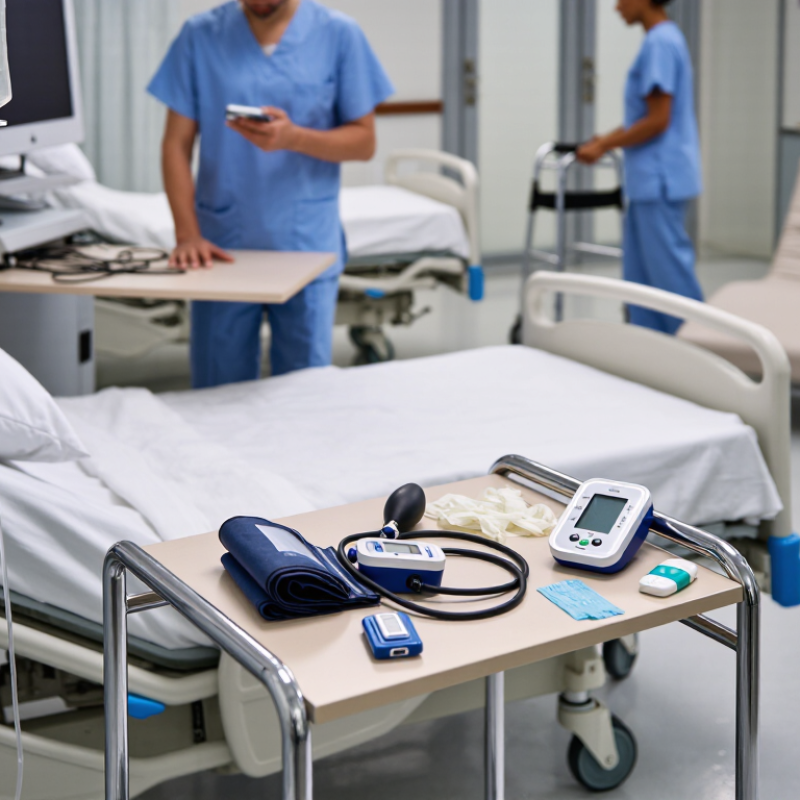
Hospital medical accessories are easiest to choose by clinical task and care setting. On general wards, bedside monitoring calls for correctly sized blood-pressure cuffs, pulse-oximeter sensors, thermometers, and ECG electrodes. Emergency departments benefit from spare probes and clearly organized leads for rapid reassessment. In critical care, respiratory circuits, oxygen masks, and suction supplies support airway care. Rehabilitation areas need gait belts, transfer boards, and mobility aids within reach.
In wound-care rooms, dressing sets, measuring guides, and cleanable trays help staff prepare supplies at the point of care. Shared cuffs and probes need clear cleaning instructions. The WHO’s 2022 Global report on infection prevention and control estimates that 7 in 100 patients in acute-care hospitals in high-income countries acquire at least one healthcare-associated infection; the estimate is 15 in 100 in low- and middle-income countries. That makes validated reprocessing and appropriate single-patient-use items important. The categories overlap, and that is easy to overlook.
Tips: Match accessories to the task, patient size, and care area. Label storage bins by use, not just by device name. Check cleaning guidance and compatibility before adding unfamiliar accessories to a care workflow.
Select PPE and Hand-Hygiene Supplies Using WHO’s Five Moments Framework
What Are the Top Medical Accessories for Hospitals?
Choosing hospital accessories around WHO’s Five Moments makes stocking practical. Keep alcohol-based hand rub at the point of care, with sinks, liquid soap, and single-use towels available for visibly soiled hands. WHO’s framework covers hand hygiene before patient contact, before clean or aseptic procedures, after body-fluid exposure risk, after patient contact, and after touching patient surroundings. The last moment is easy to overlook.
Pair hand-hygiene supplies with task-appropriate PPE: gloves, gowns, medical masks, and eye protection when exposure assessment calls for them. Gloves do not replace hand hygiene; clean hands before putting them on and after removing them. Place dispensers near beds and procedure areas, and keep clean supplies apart from used equipment. Labels should remain readable. Small details matter.
The need is measurable. WHO’s 2022 Global report on infection prevention and control estimates that about 7 in 100 patients in high-income countries and 15 in 100 in low- and middle-income countries acquire at least one healthcare-associated infection during an acute-care hospital stay. These figures support reliable access, not indiscriminate PPE use. Track supply refills and observe hand-hygiene practice. A full dispenser is reassuring, but it proves little about correct timing. Staff feedback can expose awkward placement; a checklist alone may miss the crowded bedside.
Top Medical Accessories for Hospitals: WHO’s Five Moments
Hand hygiene is indicated at each of the five moments. Keep alcohol-based hand rub accessible at the point of care; provide sinks, soap, and disposable towels for handwashing. Select gloves, gowns, masks, and eye protection according to the anticipated exposure risk. Gloves do not replace hand hygiene.
A value of 1 means hand hygiene is indicated at that moment; it does not represent measured supply use or patient outcomes.
Compare Patient Monitors and Diagnostic Tools by Measurement Function
Patient monitors track changing physiology at the bedside. Depending on the model and setup, they may display heart rate, oxygen saturation, blood pressure, respiratory rate, and temperature. Their value is trend visibility: a nurse can notice a falling oxygen level or rising pulse without repeating every measurement manually. Alarms can prompt assessment, but motion, poor sensor contact, or low circulation may distort readings. Context matters. A monitor shows signals, not the whole patient.
Diagnostic tools answer narrower measurement questions. A thermometer checks temperature; a blood pressure cuff measures pressure during a specific reading; a pulse oximeter estimates blood oxygen saturation. An electrocardiograph records the heart’s electrical activity for review, while a stethoscope helps clinicians assess sounds directly. These tools may confirm, clarify, or challenge what a monitor suggests. They are not interchangeable. A spot measurement can miss a brief change, while continuous monitoring can produce artifacts that look concerning.
Choosing between them depends on the clinical task, patient condition, and required frequency of measurement. For an unstable patient, continuous monitoring may support close observation; for a routine assessment, targeted tools may provide the needed data with less equipment. Staff should check fit, placement, and device function, then compare unexpected results with the patient’s symptoms and a repeat measurement when appropriate. Even a familiar reading can mislead. That part deserves attention.
Review Catheters and Lines Against WHO’s HAI Estimates: 7/100 vs. 15/100
For hospital teams choosing catheters and lines, the “7/100 versus 15/100” comparison needs careful reading. WHO’s 2022 Global Report on Infection Prevention and Control estimates that about 7 in 100 patients in acute-care hospitals in high-income countries, and 15 in 100 in low- and middle-income countries, acquire at least one healthcare-associated infection. These are overall HAI estimates, not catheter- or line-specific rates. The distinction matters. A catheter can be necessary, but it also creates a potential route for infection.
Useful accessories include securement devices, needleless connectors, and closed urinary drainage systems. Their value depends on correct selection and consistent handling. CDC’s National Healthcare Safety Network surveillance reports track device-associated infections, including central line-associated bloodstream infections and catheter-associated urinary tract infections. This supports monitoring specific device risks rather than treating the WHO figures as accessory performance data. At the bedside, staff should check connections, keep drainage tubing off the floor, and review whether each device remains necessary. Small details count. A cap alone cannot prevent infection if hand hygiene or access technique is poor. That is easy to overlook during busy shifts. No accessory removes risk, and local protocols still need regular review.
What Are the Top Medical Accessories for Hospitals? — Catheters and Lines in the Context of WHO’s HAI Estimates: 7/100 vs. 15/100
| Accessory |
Typical hospital use |
Potential infection concern |
Practical prevention measures |
| Peripheral intravenous (IV) catheter |
Short-term access for fluids, medicines, or blood products. |
Insertion-site infection or bloodstream infection can occur, although many healthcare-associated infections are not related to IV devices. |
Use aseptic insertion and access practices; inspect the site regularly; remove the catheter when it is no longer needed. |
| Central venous catheter (CVC) |
Vascular access for treatments such as critical-care infusions, long-term therapy, or hemodynamic monitoring. |
Central line–associated bloodstream infection (CLABSI) is a recognized device-associated infection risk. |
Use trained staff, maximal sterile barriers for insertion, appropriate skin antisepsis, clean access technique, and daily review of whether the line is still necessary. |
| Urinary catheter |
Bladder drainage when clinically indicated, including selected perioperative or critical-care situations. |
Catheter-associated urinary tract infection (CAUTI) is a recognized risk, particularly when catheterization is prolonged. |
Insert only for an appropriate indication, maintain a closed drainage system, keep urine flow unobstructed, and remove the catheter as soon as possible. |
| Endotracheal tube |
Maintains an airway and supports mechanical ventilation. |
Invasive ventilation is associated with risk of ventilator-associated pneumonia; the tube is one part of a broader risk picture. |
Follow local ventilator-prevention protocols, provide appropriate oral care, maintain proper positioning, and assess readiness to reduce or stop ventilation. |
| Enteral feeding tube |
Delivers nutrition or medication when a patient cannot safely take them by mouth. |
Potential concerns include aspiration and contamination during handling; risks depend on the patient and care practices. |
Confirm placement according to clinical policy, use clean handling practices, and follow feeding and aspiration-prevention protocols. |
| WHO HAI context |
WHO reports that, on average, about 7 in 100 patients in acute-care hospitals in high-income countries and 15 in 100 patients in low- and middle-income countries acquire at least one healthcare-associated infection during their hospital stay. These are overall HAI estimates—not infection rates for catheters, lines, or any individual accessory. |
Assess Infection-Control Needs: CDC Reports 1 in 31 U.S. Hospital Patients Has an HAI
CDC’s 2015 HAI prevalence survey found that about 1 in 31 U.S. hospital patients had at least one healthcare-associated infection. This is a snapshot, not a prediction for every ward. Still, it makes infection-control accessories essential operational tools. Small details matter.
Prioritize alcohol-based hand-rub dispensers near entrances and bedsides, alongside gloves, gowns, and eye protection suited to isolation protocols. CDC’s Core Infection Prevention and Control Practices recommend accessible hand-hygiene supplies and appropriate personal protective equipment. Consider hands-free waste bins, sealed sharps containers, and EPA-registered disinfectant wipes compatible with high-touch surfaces. Clear labels and reliable restocking matter, too.
WHO’s 2022 Global Report on Infection Prevention and Control estimates that 7 in 100 patients in acute-care hospitals in high-income countries acquire at least one HAI; the estimate is 15 in 100 in low- and middle-income countries.
These figures are not a scorecard for any single facility. A stocked cart can still fail when supplies are out of reach or dispensers run empty. That deserves honest review. Track refill gaps, PPE availability, and cleaning-product contact times during shift changes, then adjust placement with frontline staff.